AIML-500 · Artifact 03 · Discussion 3.4
Neural Networks Made Simple
How does a neural network learn to make a prediction?
Start with a decision you already make by feel: picking a ripe avocado.
Download the original slides PDF · 7 slides ↓Introduction Link to heading
At the grocery store, you might check an avocado’s color, feel how much it gives under gentle pressure, and look at the stem. Some of those clues will matter more to your decision than others. A neural network also combines clues, using numerical weights that it adjusts during training.
Description Link to heading
This beginner’s guide adapts a group presentation I helped create for AIML-500 Discussion 3.4 into a web lesson. It includes a network diagram, a clue-scoring activity, and a walkthrough of the training loop. Download the original slides (PDF).
From rules to examples Link to heading
Suppose you want to flag spam. You could write a rule that flags any email containing “FREE.” That can catch some spam, but a real promotion could contain the word and a scammer could avoid it. In supervised learning, you instead give the model emails already labeled as spam or legitimate. During training, the model adjusts its weights to pick up combinations of clues that help it predict those labels.
From clues to a prediction Link to heading
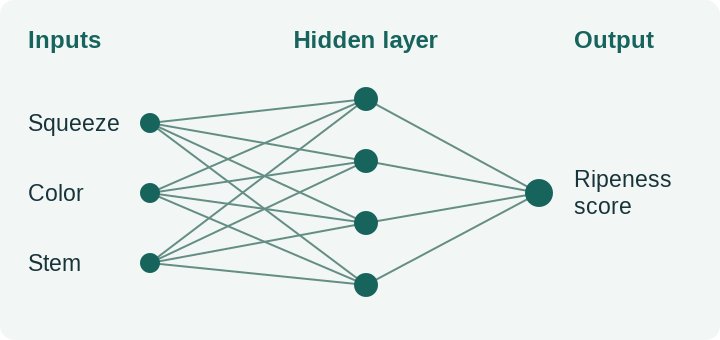
For the avocado example, the inputs represent what you can observe about the squeeze, color, and stem. In this simplified network, the hidden layer combines those inputs in several ways. Each connection has a weight, and each hidden unit transforms its weighted combination before passing it on. The output combines those intermediate signals into a ripeness score.
Try the clues Link to heading
In this simplified scoring example, a gentle squeeze carries more weight than color or stem. Select the clues you observe and see which ones move the score the most.
Illustrative score
How a network learns Link to heading
A supervised training example includes both the clues and a known answer. A network makes a prediction, measures how far it was from that answer, and uses the error to adjust its weights.
- 01GuessThe network predicts that an avocado is ripe.
- 02CheckThe known answer says it is still hard and unripe.
- 03AdjustUse the prediction error to update the weights.
- 04RepeatKeep learning across many labeled examples.
After training, evaluate the network on examples kept separate from training. New avocados help you check whether the model can apply what it learned to cases it hasn’t seen. If the training examples mostly came from one variety, a color clue that worked there may be less useful on a different variety.
Where you encounter it Link to heading
- Spam filtering. A neural network can learn signals that help distinguish junk mail from legitimate messages. An unusual invoice can still end up in junk, and a new scam can slip through.
- Face unlock. A neural network can turn facial features into a representation that the device compares with the enrolled face.
- Movie recommendations. A neural network can use patterns in viewing activity to help rank titles someone might enjoy.
The next time you make a decision by feel, ask what clues you use, how you know the right answer, and what examples you would set aside to test a model.
Objective Link to heading
Explain the fundamentals of neural networks to readers new to machine learning. By the end, readers should be able to identify an input, describe what a weight does, and explain why a model is evaluated on examples it hasn’t seen.
Process Link to heading
Our group worked together in person. A teammate suggested the avocado example, and we used it to connect learning from labeled examples to a familiar decision. The slides follow that example through prediction, training, and testing. The web edition turns that sequence into readable sections, redraws the network diagram, and adds a small scoring activity so readers can compare the influence of different clues.
Tools and Technologies Used Link to heading
The original slides disclose an initial draft by OpenAI ChatGPT (Codex), followed by simplification, reframing around an everyday example, and regeneration with Anthropic Claude. This web edition uses Hugo, Markdown, HTML, SVG, and JavaScript.
Value Proposition Link to heading
This guide gives students and colleagues new to AI a familiar way to talk about model inputs, training examples, and testing. They can use those concepts to ask clearer questions about what an AI feature learns from and when its predictions may be unreliable.
Unique Value Link to heading
The same avocado example connects each part of the explanation, from the initial clues to the held-out test. The scoring activity makes the influence of each clue visible, while the network diagram shows how several clues can be combined across layers.
Relevance Link to heading
For students or collaborators encountering neural networks for the first time, the guide offers a starting point for conversations about data quality and model behavior without requiring code or prior math coursework.
References Link to heading
Neural Networks Made Simple. (2026). [AIML-500 Discussion 3.4 group presentation, Indiana Wesleyan University]. Original presentation (PDF).